Client Acquisition
Offer KitSpecialization Decision Playbook
Niche positioning kit for independent consultants ready to stop competing on price.
What's in the kit
- Niche Scoring Matrix: rate every option, pick one with evidence
- ICP Worksheet: seven-attribute client profile, consulting-specific format
- Specialist Rate Formula: positioning strategy for independent consultants, 2–3x baseline
- 48-Hour Checklist: specialization vs generalist decision made and deployed fast
The situation
Why this kit exists.
If you're figuring out how to niche down as a consultant without losing clients, you already know the core problem: you're good at what you do, you have the track record, and you're still losing engagements to someone narrower. Not because they're better. Because the client looked at their positioning and saw certainty. They looked at yours and saw options. That's a pricing problem disguised as a marketing problem, and it compounds every year you stay general.
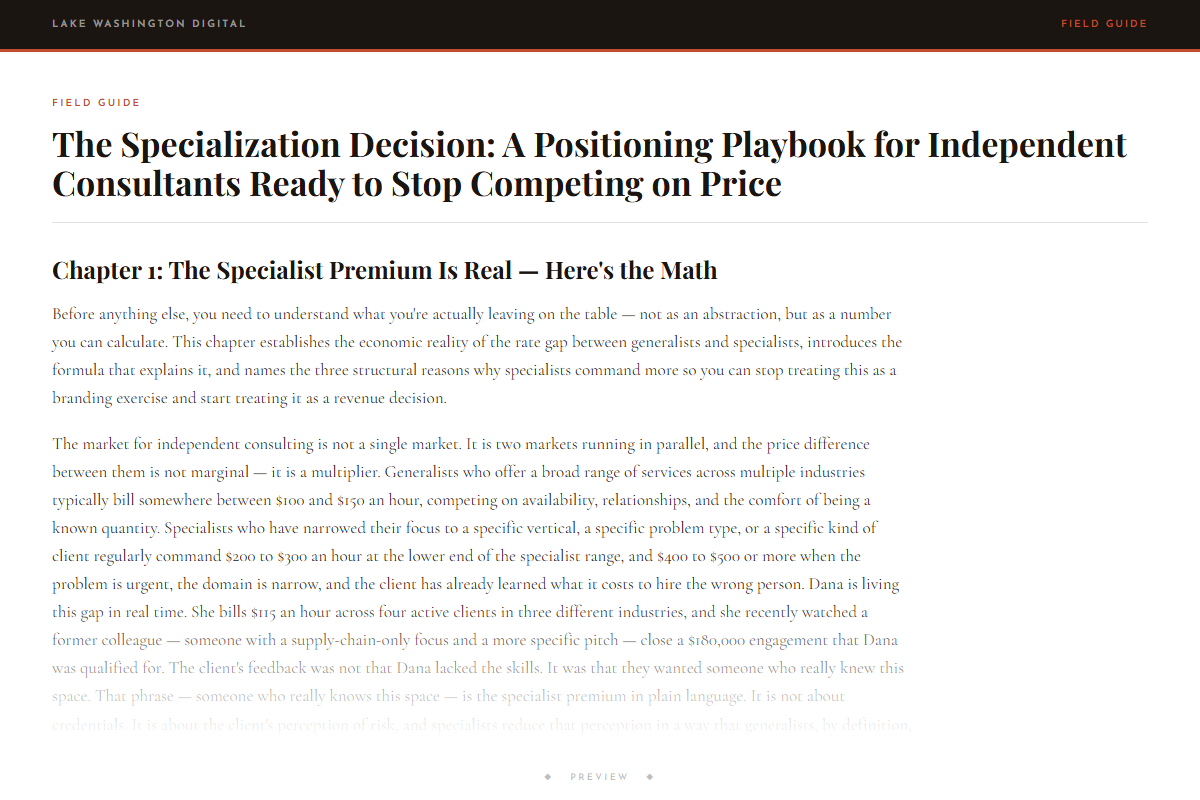
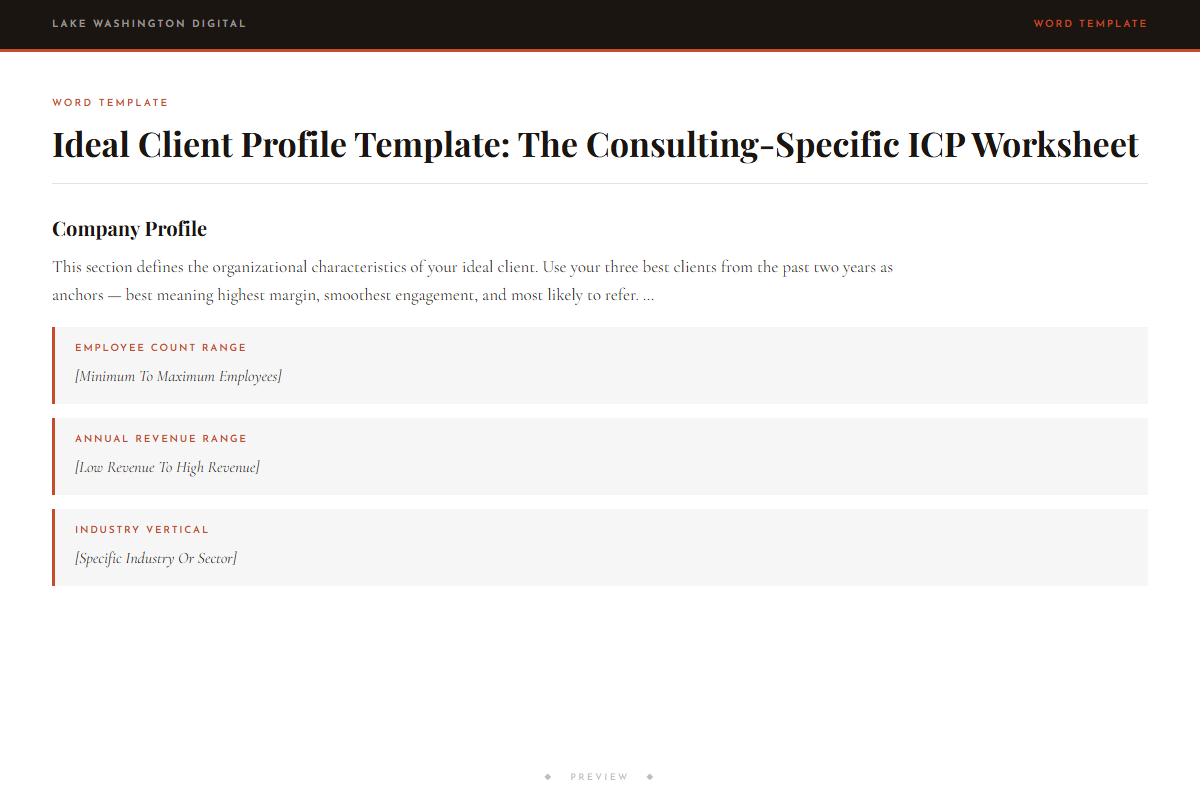
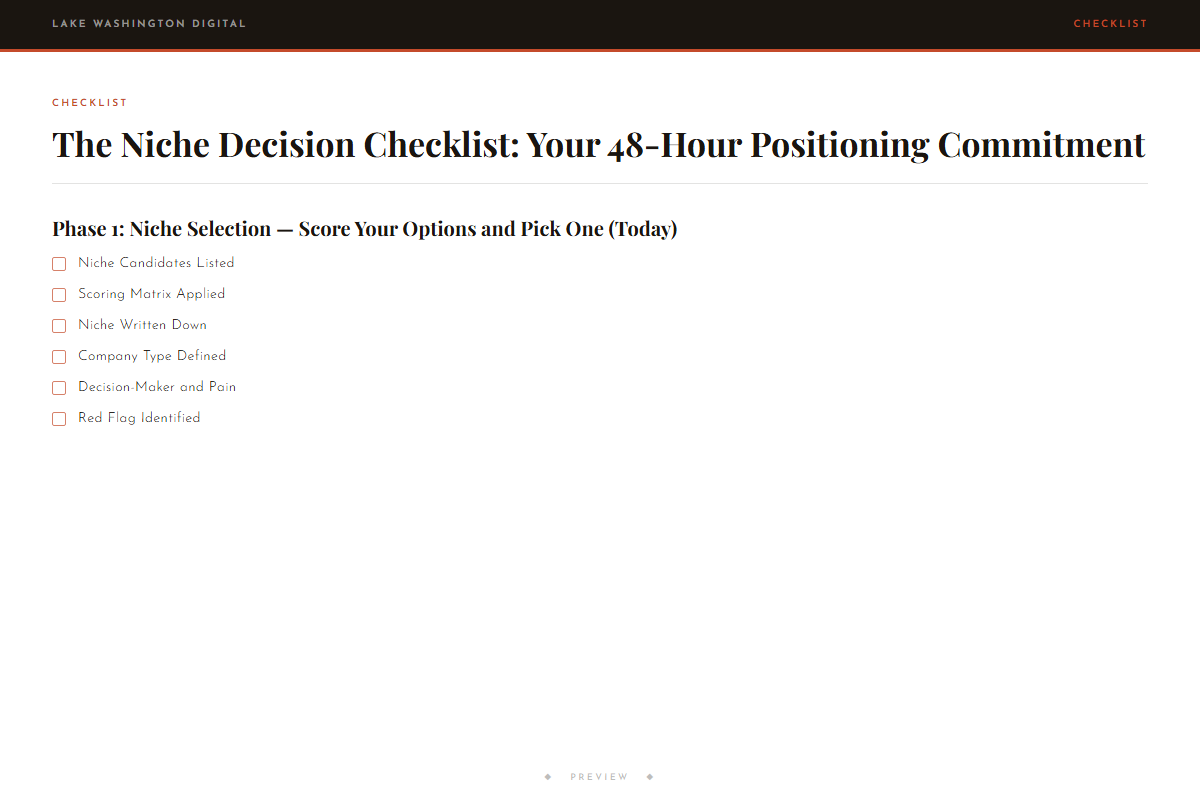
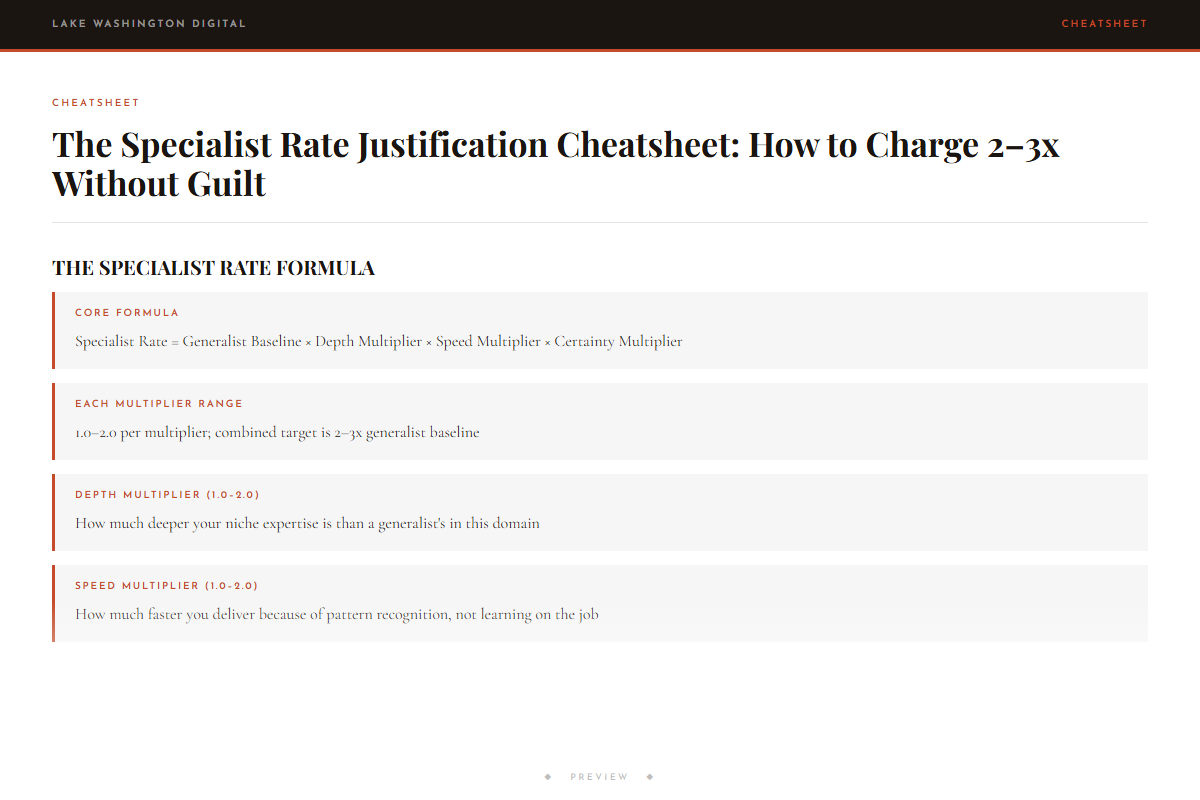
This kit is four tools built for the decision itself. The Specialization Decision Playbook (PDF guide) walks you through the niche scoring matrix — rate each option on existing proof, market demand, revenue potential, and personal conviction — and lands you on a defensible choice. The Consulting-Specific ICP Worksheet (DOCX template) builds out your ideal client profile across seven attributes: company size, revenue range, growth stage, decision-maker role, specific problem, budget and engagement model, and red flags to reject. The Niche Decision Checklist (PDF) runs you through the 48-hour commitment sequence so you don't stall after the decision. The Specialist Rate Justification Cheatsheet (PDF) gives you the three-angle framework for raising consultant rates by niching — expertise premium, risk reduction, and speed to outcome — with language you can use in the actual proposal conversation.
Here's how operators use it: score your niche options with the matrix, fill in the ICP worksheet for your top choice, draft your positioning statement using the formula in the guide (I help [specific client type] who are struggling with [specific problem] achieve [specific outcome] — without [common fear or trade-off]), then identify three prospects to pitch within 48 hours. The cheatsheet goes into your proposal folder and stays there. The whole sequence takes an afternoon if you don't overthink it.
This kit came out of watching a straightforward pattern repeat: generalist consultants with real expertise losing work to specialists with less of it, then discounting to compete. The tools here are what I built to make the specialization decision concrete instead of theoretical — a scoring system, a client profile structure, a rate justification framework. Not a course on positioning philosophy. The decision and the deployment.
If you're worried your existing generalist clients disappear the moment you specialize — they usually don't. Most clients hire you again because of the relationship and the results, not because your LinkedIn headline says 'generalist.' The ICP worksheet includes a red-flags section specifically so you can identify which current clients are worth keeping in a specialized practice and which ones were always the wrong fit. The checklist addresses the transition directly.
Download, run the scoring matrix today, and have a positioning statement drafted before the week is out. The kit is $27 at launch.
What's inside
Every file. What it does.
-
The Specialization Decision: A Positioning Playbook for Independent Consultants Ready to Stop Competing on Price
-
Ideal Client Profile Template: The Consulting-Specific ICP Worksheet
-
The Niche Decision Checklist: Your 48-Hour Positioning Commitment
-
The Specialist Rate Justification Cheatsheet: How to Charge 2–3x Without Guilt
Who this is for
You'll get immediate use from this if…
- Independent consultants with 4–10 years of generalist experience who keep losing engagements to narrower specialists and are ready to make a positioning strategy for independent consultants that actually sticks.
- Solo consultants already doing 60–80% of their work in one industry or problem type but still describing themselves as generalists — and haven't raised rates in two or more years because they don't know how to justify the specialist premium.
- Consultants actively considering specialization vs generalist consulting practice but stalling on the decision because they're afraid of losing current clients before new ones arrive.
Questions
Before you buy.
- How do I niche my consulting practice without losing existing clients?
- Most existing clients rehire you because of the relationship and the results you've delivered, not because of how broadly you're positioned. The ICP worksheet includes a red-flags section to help you identify which current clients fit a specialized practice and which ones were always misaligned. The playbook also covers how to reposition with existing clients without making it a formal announcement.
- Can I specialize as a consultant if I already have generalist clients?
- Yes, and most consultants who niche down keep the majority of their existing book for at least 12–18 months while the new positioning builds pipeline. The 48-hour checklist is designed for exactly this situation — it doesn't assume you're starting from zero. It assumes you have active clients and need a transition path, not a clean break.
- How to position yourself as a specialist consultant instead of generalist — where do I start?
- Start with the niche scoring matrix in the playbook. Score each option you're considering on four dimensions: existing proof, market demand, revenue potential, and personal conviction. The highest total score is your starting point. From there, the ICP worksheet and positioning statement formula give you the language to make it concrete and pitchable.
- Should I niche down my consulting business to charge higher rates?
- Specialization is one of the most direct paths to a specialist premium because it shifts the client's frame from 'how much does a consultant cost' to 'how much does someone who has solved this exact problem before cost.' The rate justification cheatsheet gives you the three-angle framework — expertise premium, risk reduction, speed to outcome — with language you can use in a proposal conversation, not just in your own head.
- How to tell clients you're specializing in one industry without it feeling awkward?
- The playbook covers this directly. The short version: you don't need to send an announcement. You update your positioning statement, adjust how you describe your work in new conversations, and let existing client relationships continue on their own terms. The checklist includes a step for drafting your new positioning statement so you have something concrete to say when it comes up.
More in Client Acquisition
Other kits for this situation.
Specialization Decision Playbook
Deploy the same day you download it.