Sales & Proposals
Proposal KitThe $35K Proposal Kit
Proposal structure, pricing logic, and objection scripts for $20K–$80K engagements.
What's in the kit
- Proposal Word doc: ready-to-edit structure for $20K–$80K engagements, send this week
- Pricing calculator: maps hours, margin, and risk buffer — justifies your number on paper
- Objection script pack: handles 'too expensive' and scope questions inside the proposal itself
- Pre-send checklist: quality gate plus Day 3, Day 7, Day 10 follow-up sequence built in
The situation
Why this kit exists.
If you're sending a high-ticket proposal template for service firms and getting silence, a 'can you do it for less,' or a follow-up call that shouldn't have been necessary — the proposal is doing the wrong job. Not because your price is wrong. Because the document isn't building the case before it names the number. A single-line price of $38,000 with no scope boundaries, no problem statement, no pricing logic — that's not a proposal. That's an invoice with a cover page. The CFO test fails before anyone picks up the phone.
This kit is five files: a guide PDF that walks through the full proposal narrative structure (Cover Page, Executive Summary, The Situation, Our Approach, Scope and What's Out of Scope, Investment Breakdown, Terms and Next Steps), a ready-to-customize Word doc built for $20K–$80K engagements, an Excel calculator that maps estimated hours, margin, and risk buffer to a single defensible number using the formula Estimated Hours × Hourly Rate × (1 + Margin %) + Risk Buffer = Total Investment, a script pack with talking points for the three objections that kill proposals — 'That's expensive,' 'Can you do it for less,' and 'What if scope changes' — and a pre-send checklist with a Day 3, Day 7, and Day 10 follow-up sequence built in.
Here's how you use it: open the guide first — it's not long, it's a working reference. Then pull the Word doc and run your current engagement through the section sequence. Use the calculator to build your number from the ground up instead of guessing. Drop the objection scripts into the proposal itself where scope and price appear, so the document handles the negotiation before it starts. Run the checklist before you hit send. The proposal-to-conversation gap closes when the document does the explaining.
This kit was built because a $55K proposal came back with 'we need to talk about the price' — and the real problem wasn't the price, it was that the proposal had no pricing logic, no defined engagement boundaries, and no value positioning before the investment section. Problem statement before approach, approach before price — that sequence is the entire fix. Once the structure was right, the follow-up call became a formality, not a negotiation.
If you're worried the template won't fit your engagement type: the Word doc is section-based and built to be edited. The calculator works for any hourly or phase-based service model. The objection scripts are written as talking points you adapt, not scripts you read verbatim. If you send proposals in the $20K–$80K range and you're not already winning them without a follow-up negotiation, the structure in this kit is the gap.
What's inside
Every file. What it does.
-
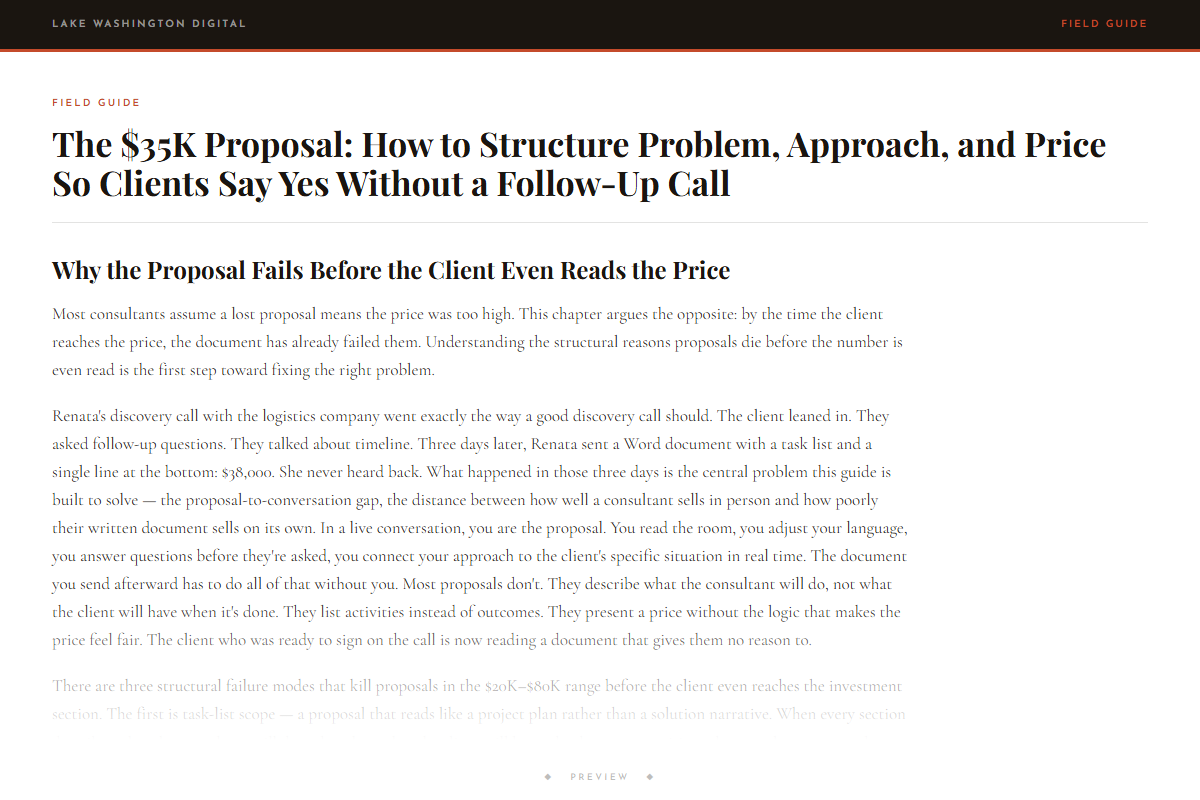
The $35K Proposal: How to Structure Problem, Approach, and Price So Clients Say Yes Without a Follow-Up Call
-

The Proposal Template: Ready-to-Customize Word Doc for $20K–$80K Engagements
-
The Pricing Breakdown Calculator: Map Hours, Margin, and Value to a Single Number
-
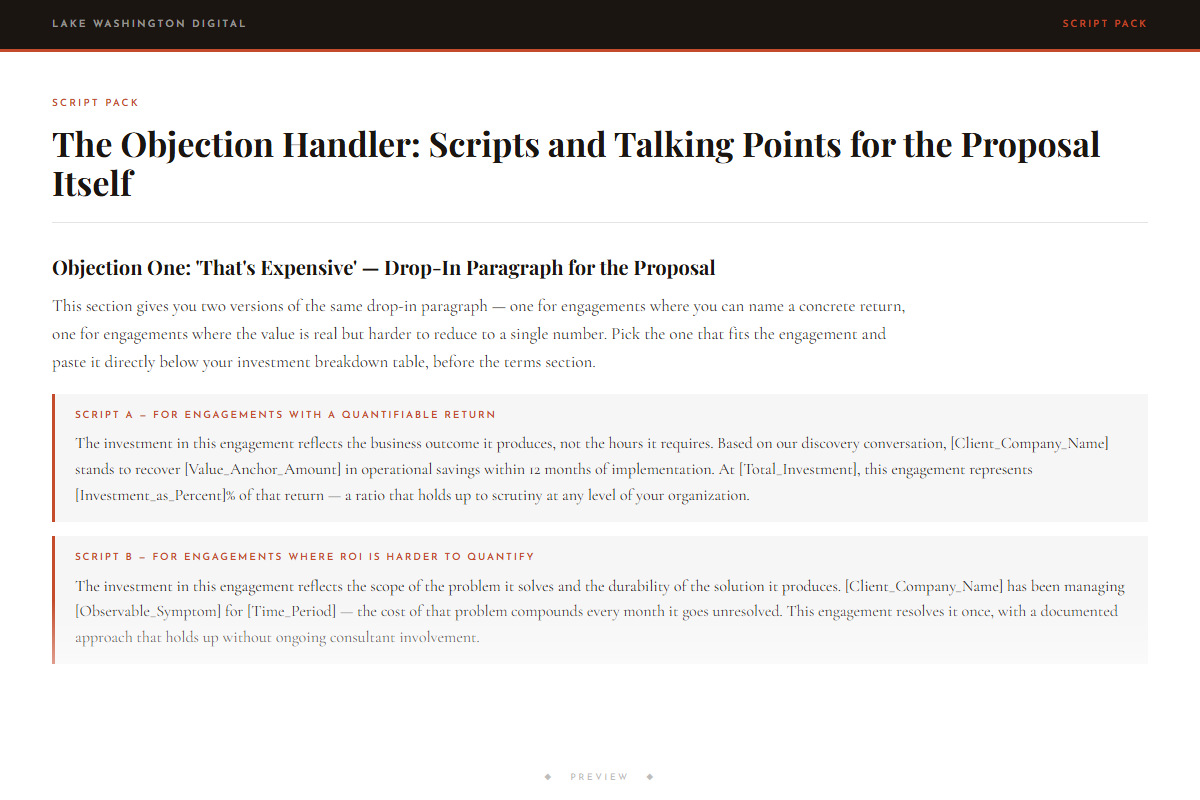
The Objection Handler: Scripts and Talking Points for the Proposal Itself
-
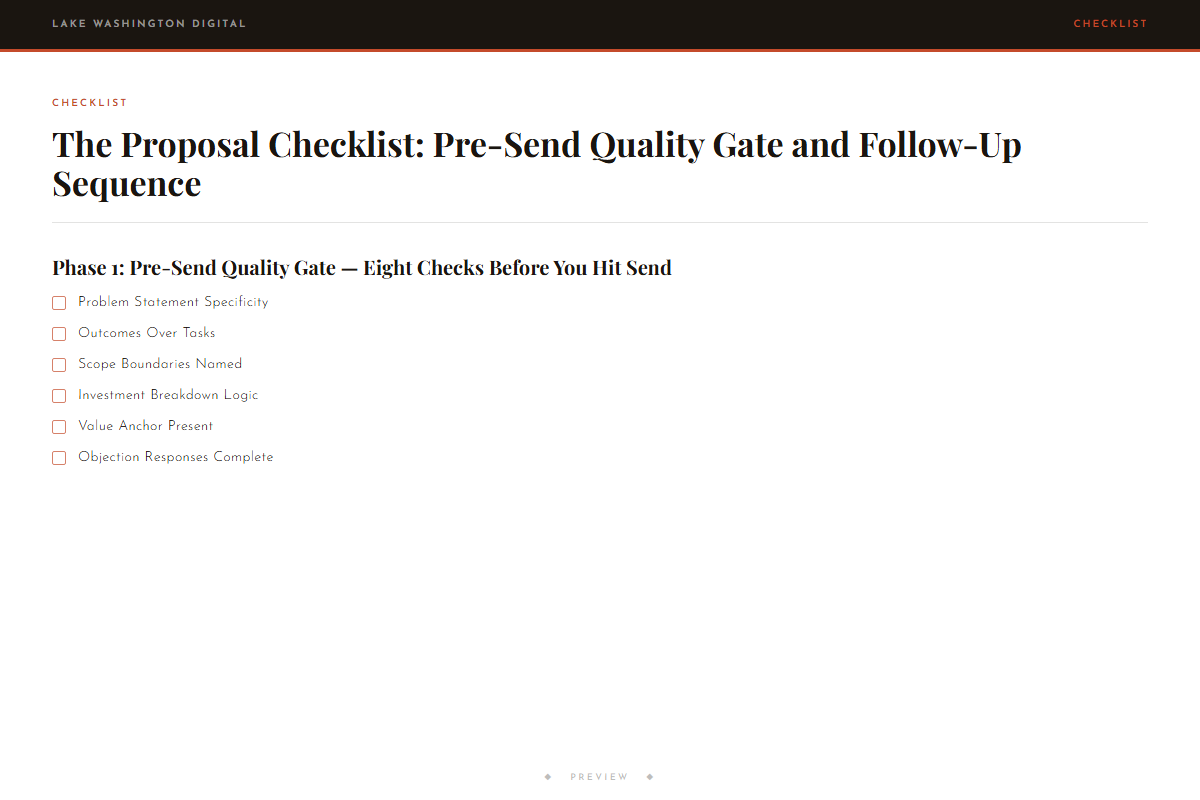
The Proposal Checklist: Pre-Send Quality Gate and Follow-Up Sequence
Who this is for
You'll get immediate use from this if…
- Independent consultants sending proposals in the $20K–$80K range who want to know how to structure a service proposal with pricing so the CFO reviewing it doesn't need a follow-up call to understand the number.
- Boutique agency owners pitching $30K to $50K engagements using a proposal template for $30k to $50k engagements that currently has no scope boundaries, no pricing logic, and no defined engagement narrative.
- Fractional executives and growth consultants who need to know how to justify high prices in client proposals — not by lowering the number, but by building the case before the investment section appears.
Questions
Before you buy.
- How do I structure a proposal so clients don't negotiate price?
- The sequence is the fix: problem statement first, approach second, price last. When a client reads the investment number after they've already agreed with your diagnosis and your plan, the number is a conclusion — not a surprise. The guide and template in this kit are built around that sequence. The objection scripts reinforce it inside the document itself.
- What should a $35K service proposal include to close without a follow-up call?
- Seven sections: Cover Page, Executive Summary, The Situation, Our Approach, Scope and What's Out of Scope, Investment Breakdown, Terms and Next Steps. The Word doc in this kit is built to that structure. The 'What's Out of Scope' section alone eliminates most of the scope-creep conversations that turn a signed engagement into an unpaid negotiation.
- How do I write a proposal that explains scope and pricing clearly enough that the client doesn't need me to walk them through it?
- Two things: the proposal narrative has to build the case before the number appears, and the pricing section has to show the logic — not just the total. The calculator in this kit outputs a breakdown by hours, rate, margin, and risk buffer. When a client can see how the number was built, they're reviewing a calculation, not questioning a guess.
- Why do clients push back on proposal prices, and how do I prevent it?
- Usually because the price appears before the value is established, or because there are no scope boundaries — so the client is mentally adding everything they might want to the engagement. This kit addresses both: the template puts investment after approach, and the scope section explicitly names what's not included. The objection handler gives you the talking points for the cases where pushback still happens.
- How do I present pricing in a proposal without losing the deal?
- Lead with the problem you're solving and what it's costing them. Then show your approach. Then name the investment as the cost of executing that approach — not as a fee for your time. The value positioning rule in this kit is: problem before approach, approach before price. The template enforces that order. The pricing calculator gives you a number you can defend line by line if asked.
More in Sales & Proposals
Other kits for this situation.
The $35K Proposal Kit
Deploy the same day you download it.