Sales & Proposals
Prompt SystemRate Conversation Playbook
Pricing objection response system for independent service operators.
What's in the kit
- Rate Objection Decision Tree: routes you to Hold, Flex, or Walk in real time
- Three-objection script system: word-for-word responses for handling price pushback from prospects
- Budget vs. value diagnostic: know what to say when client says price is too high
- 90-minute follow-up email template: closes the loop before prospect attention shifts
The situation
Why this kit exists.
Knowing how to respond to pricing objections in sales is the difference between closing at your number and watching a deal die in follow-up silence. Most service operators freeze when a prospect says 'that's more than we were expecting' — and the freeze costs them. They discount before they've diagnosed the problem. They offer scope reductions they immediately regret. They send a vague follow-up email three days later and never hear back. The issue isn't confidence. It's not having a system.
This kit is two assets: The Rate Conversation Playbook (guide PDF) and the Rate Objection Decision Tree: One-Page Hold/Flex/Walk Guide (cheatsheet PDF). The playbook walks you through the three objection types — TOO HIGH, NEED TO THINK, and CAN YOU DO IT FOR LESS — and gives you word-for-word responses for each. The decision tree is a single laminated-ready page you keep open during calls. It routes you to HOLD, FLEX SCOPE, or WALK based on what the prospect actually said.
Here's how you use it: before your next discovery call, read the playbook once. It takes about 25 minutes. Pull up the decision tree during the call. When the rate objection lands, you run the two-question diagnostic — budget misalignment or value misalignment — before you say anything about price. Budget misalignment means the prospect has real budget but anchored low. Value misalignment means they don't yet see the outcome as worth the number. Those two problems have different responses. The playbook gives you both. After the call, you send the follow-up email within 90 minutes — the kit includes the template — before the prospect's attention moves to the next thing on their list.
This was built because of a specific situation: a $5,200 engagement lost after discounting twice on the same call — first to $4,500, then to $3,800 — and still not closing, because the prospect's real issue was value misalignment, not budget. Dropping the number twice didn't fix the problem. It just confirmed that the number was negotiable. The Rate Floor Rule in this kit exists because of that call: never name a lower number until you've confirmed which type of misalignment you're dealing with.
This is not a negotiation course. There's no theory, no frameworks to internalize, no mindset work. It's a decision tree and a script system. You open it, you use it, you close at your number or you walk with your positioning intact.
Download, read the playbook once, print the decision tree, and have it open on your next call. That's the whole deployment.
What's inside
Every file. What it does.
-
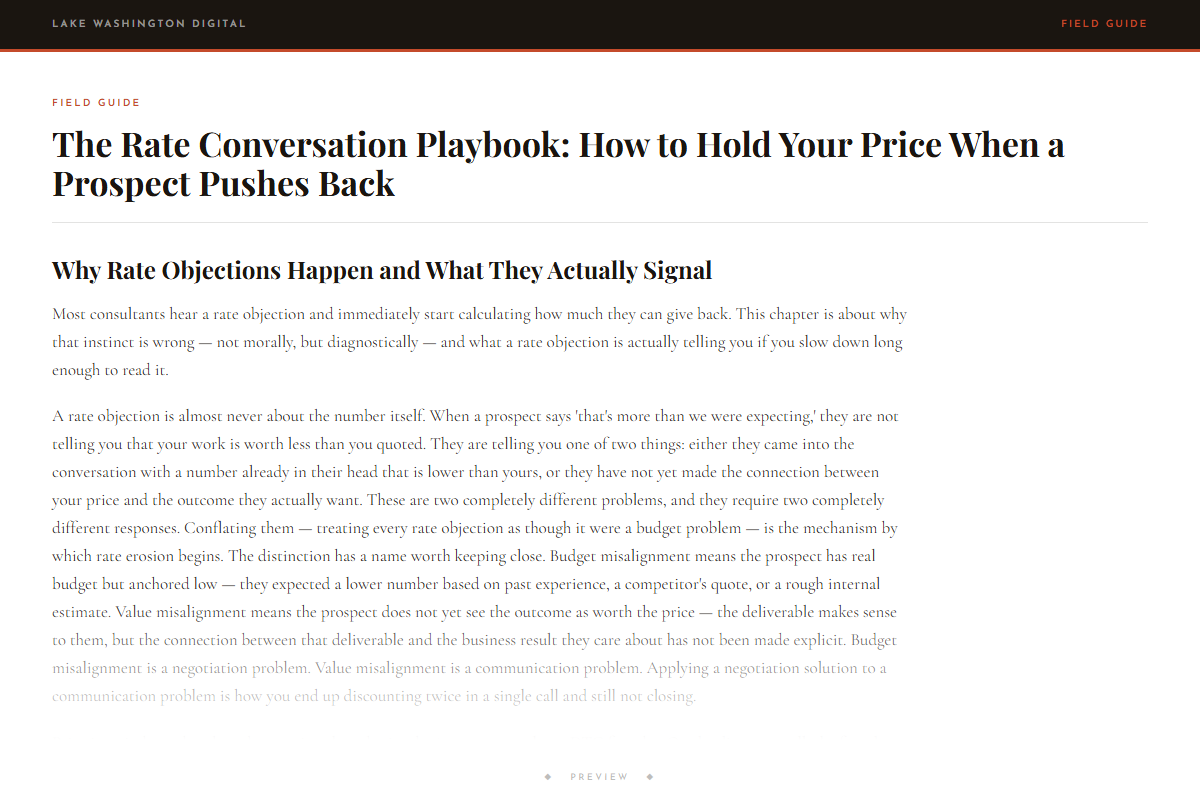
The Rate Conversation Playbook: How to Hold Your Price When a Prospect Pushes Back
-
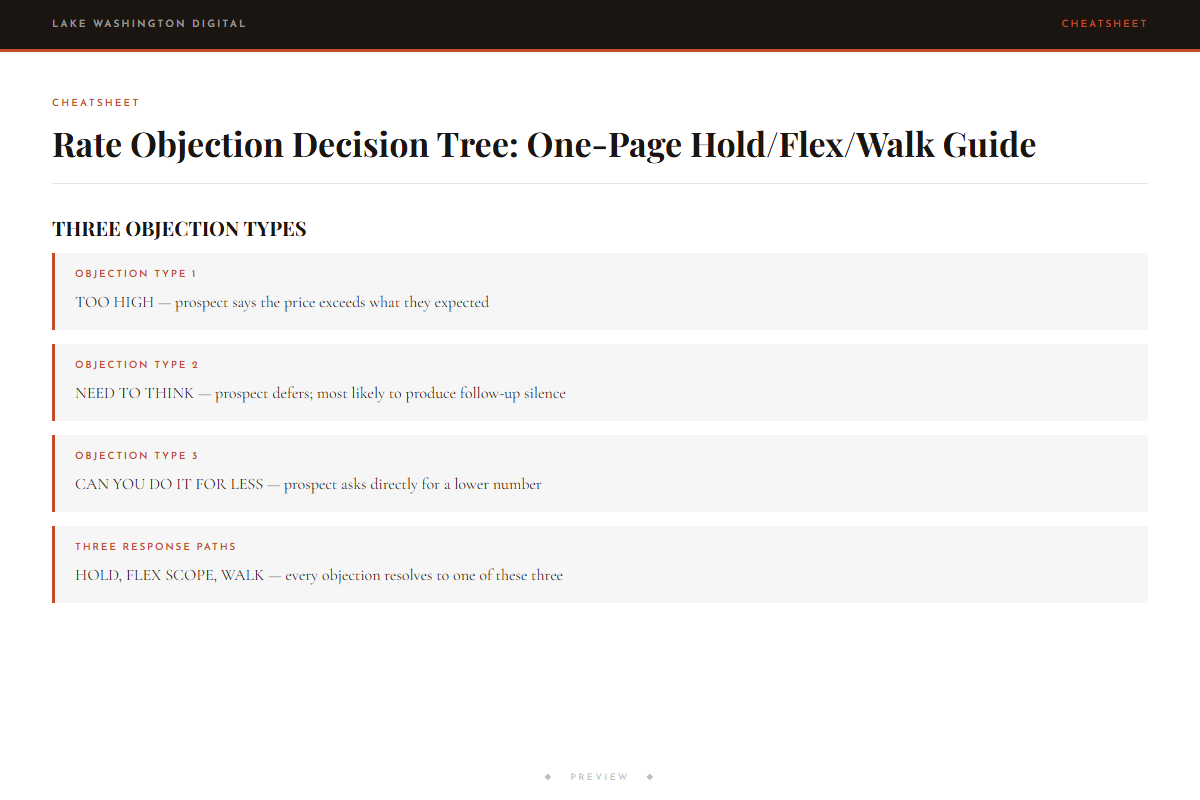
Rate Objection Decision Tree: One-Page Hold/Flex/Walk Guide
Who this is for
You'll get immediate use from this if…
- Independent consultants and strategists who have frozen on a discovery call when a prospect pushed back on price and discounted before diagnosing the real objection — and want sales scripts for price negotiations they can use immediately.
- Fractional operators and agency owners quoting $3K–$10K engagements who have watched deals die in follow-up silence after a prospect said 'we need to think about it' — and never sent a structured next-move email.
- Solo service providers who know what to say when a client says their price is too high but keep capitulating anyway because they don't have a decision system to run in the moment.
Questions
Before you buy.
- What do you say when a prospect says your price is too high?
- The playbook gives you the exact response for this objection — it's labeled TOO HIGH in the decision tree. The first move is not to defend the number. It's to run the two-question diagnostic to determine whether you're dealing with budget misalignment or value misalignment. The response is different for each. Both are in the kit.
- How do you hold your price without losing the deal?
- The Rate Floor Rule in the playbook covers this directly: never name a lower number until you've confirmed which type of misalignment you're dealing with. Dropping your price before you've diagnosed the problem doesn't close deals — it just signals that your number is negotiable. The HOLD path in the decision tree gives you the language to stay at your rate while keeping the conversation open.
- How do you respond when a prospect says that costs more than expected?
- This is one of the three objection types covered in the playbook. The response starts with a single clarifying question — not a justification of your price. The playbook gives you the exact phrasing and explains why defending the number first accelerates rate erosion.
- Is there a sales email template for when a prospect goes silent after a quote?
- Yes. The playbook includes a post-call follow-up email template built for the follow-up silence scenario. The kit's guidance is to send it within 90 minutes of the call ending — before the prospect's attention moves to the next item on their list. The template is structured to surface the real objection without re-opening the price.
- How do you know if a prospect is really concerned about budget or value?
- The playbook's two-question diagnostic is built specifically for this. Budget misalignment means the prospect has real budget but anchored low — they can pay, they just expected a lower number. Value misalignment means they don't yet see the outcome as worth the price. Those two problems require different responses. Discounting for a value misalignment doesn't close the deal — Camille's situation in the playbook is a direct example of this.
More in Sales & Proposals
Other kits for this situation.
Field guide
Go deeper on the situation.
Rate Conversation Playbook
Deploy the same day you download it.